
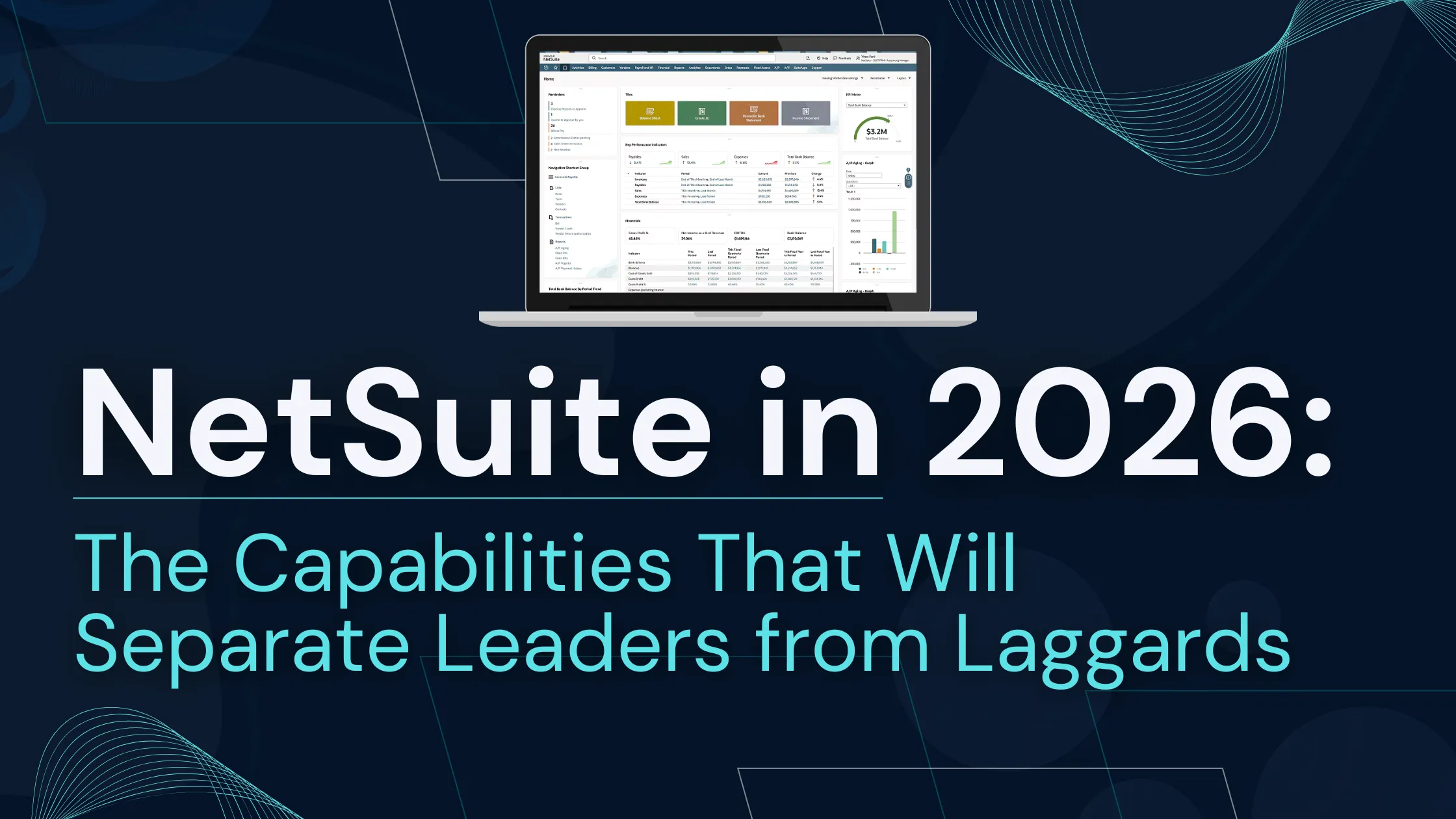
For years, ERP success was defined by one milestone: go-live. If the system was stable, transactions posted correctly, and finance could close the books, the implementation was considered successful.
That definition no longer holds.
Today, CFOs, COOs, and operations leaders are asking very different questions:
-
Can NetSuite help us make decisions faster?
-
Can it highlight risks before they become problems?
-
Can it scale as our business model changes?
-
Can it adapt without constant rework?
As we move toward 2026, NetSuite customers are clearly splitting into two groups:
-
Organizations using NetSuite primarily as a transaction processing system
-
Organizations using NetSuite as an intelligent, decision-support, and automation platform
The difference is not the NetSuite edition or modules they own. It’s how intentionally the system has been designed, governed, and evolved.
Below are the capabilities and design principles that will separate NetSuite leaders from laggards in 2026.
1. NetSuite Is Evolving from ERP to Intelligent Business Platform
NetSuite is no longer just a system of record. It is increasingly becoming a system of insight and action. In real-world implementations, finance and operations leaders expecting:
-
Exception-based reporting instead of static monthly reports
-
Real-time visibility instead of delayed analysis
-
Automated alerts instead of manual monitoring
Tools like SuiteAnalytics, dashboards, saved searches, and workflow-driven notifications are no longer “nice-to-have” features. They are becoming central to how leaders run the business.
By 2026, organizations that still rely on Manual report generation, Spreadsheet-heavy analysis, Reactive problem-solving will find themselves at a disadvantage.
What leaders are doing differently today:
-
Designing dashboards around decisions, not raw data
-
Shifting reporting from “what happened” to “what needs attention now”
-
Embedding intelligence directly into daily operations
2. AI and Automation Will Reward Strong Foundations and Expose Weak Ones
AI is one of the most talked-about topics in ERP, and one of the most misunderstood. Here is the reality seen across NetSuite environments:
AI does not fix poor system design, it exposes it. As NetSuite expands predictive analytics, anomaly detection, and automated insights, the accuracy and usefulness of those capabilities depend entirely on the quality of the underlying data.
AI outcomes are heavily influenced by:
-
A clean and logical chart of accounts
-
Consistent transaction structures
-
Standardized processes across teams and entities
Organizations that invested early in data discipline and thoughtful automation are already seeing value. Those with fragmented data and inconsistent processes are seeing noise instead of insight.
What successful organizations are doing now:
-
Simplifying and standardizing the chart of accounts
-
Enforcing consistent transaction entry rules
-
Automating processes before layering intelligence on top
In 2026, AI will not be optional, but it will only be effective for those who prepared properly.
3. Customization Is Giving Way to Configuration Discipline
One of the most common long-term risks in NetSuite environments is over-customization. Many organizations customized NetSuite to mirror legacy systems, unintentionally creating:
-
Upgrade challenges
-
Maintenance overhead
-
Dependency on complex scripts
NetSuite’s roadmap clearly favors:
-
Native functionality
-
Low-code automation through SuiteFlow
-
Upgrade-safe configurations
This does not mean eliminating customization entirely. It means using customization intentionally and sparingly, only when it delivers clear business value. In 2026, the strongest NetSuite environments will be:
-
Easier to maintain
-
Faster to enhance
-
Less dependent on heavy scripting
What leaders are doing now:
-
Auditing existing customizations
-
Replacing custom scripts with native features where possible
-
Documenting the business rationale behind every customization decision
4. Real-Time Visibility Is Becoming a Leadership Expectation
Executives no longer want more reports. They want clarity, confidence, and answers. In 2026, leadership teams will expect:
-
Real-time cash and liquidity visibility
-
Margin insights by product, customer, and region
-
Early warning signals for operational bottlenecks
NetSuite already contains the unified data needed to deliver this visibility. The difference lies in how reporting is designed. Organizations that treat reporting as a back-office task often struggle to deliver insight. Those that treat it as a leadership enablement tool gain a significant advantage.
What successful organizations are doing now:
-
Defining a small set of leadership-critical KPIs
-
Designing dashboards for executives, not analysts
-
Eliminating reports that do not drive action
5. NetSuite ROI in 2026 Will Be Measured by Agility
Historically, ERP ROI was measured by stability and control. In 2026, it will be measured by adaptability. Organizations will evaluate NetSuite based on how easily it supports:
-
New revenue models
-
Mergers and acquisitions
-
Global expansion
-
Regulatory and supply chain changes
NetSuite environments designed with scalability in mind consistently outperform those built only to meet immediate needs.
What forward-looking organizations are doing now:
-
Reviewing their NetSuite design annually
-
Planning for change, not just current operations
-
Treating NetSuite as a living platform rather than a completed project
NetSuite Success Is Now a Strategy, not a Project
What will separate NetSuite leaders from laggards in 2026 is not the software itself. It will be:
-
Strategic system design
-
Strong data foundations
-
Automation-first thinking
-
A long-term mindset
NetSuite success is no longer achieved at go-live. It is achieved through continuous evolution, governance, and alignment with business strategy. Organizations that recognize this today will be the ones extracting real value from NetSuite tomorrow.
If you are evaluating where your NetSuite environment needs to be in the next 12–24 months, Empower Growth Solutions works with finance and operations leaders to design NetSuite environments that solve today’s challenges while preparing for what’s next.

0 Comments