
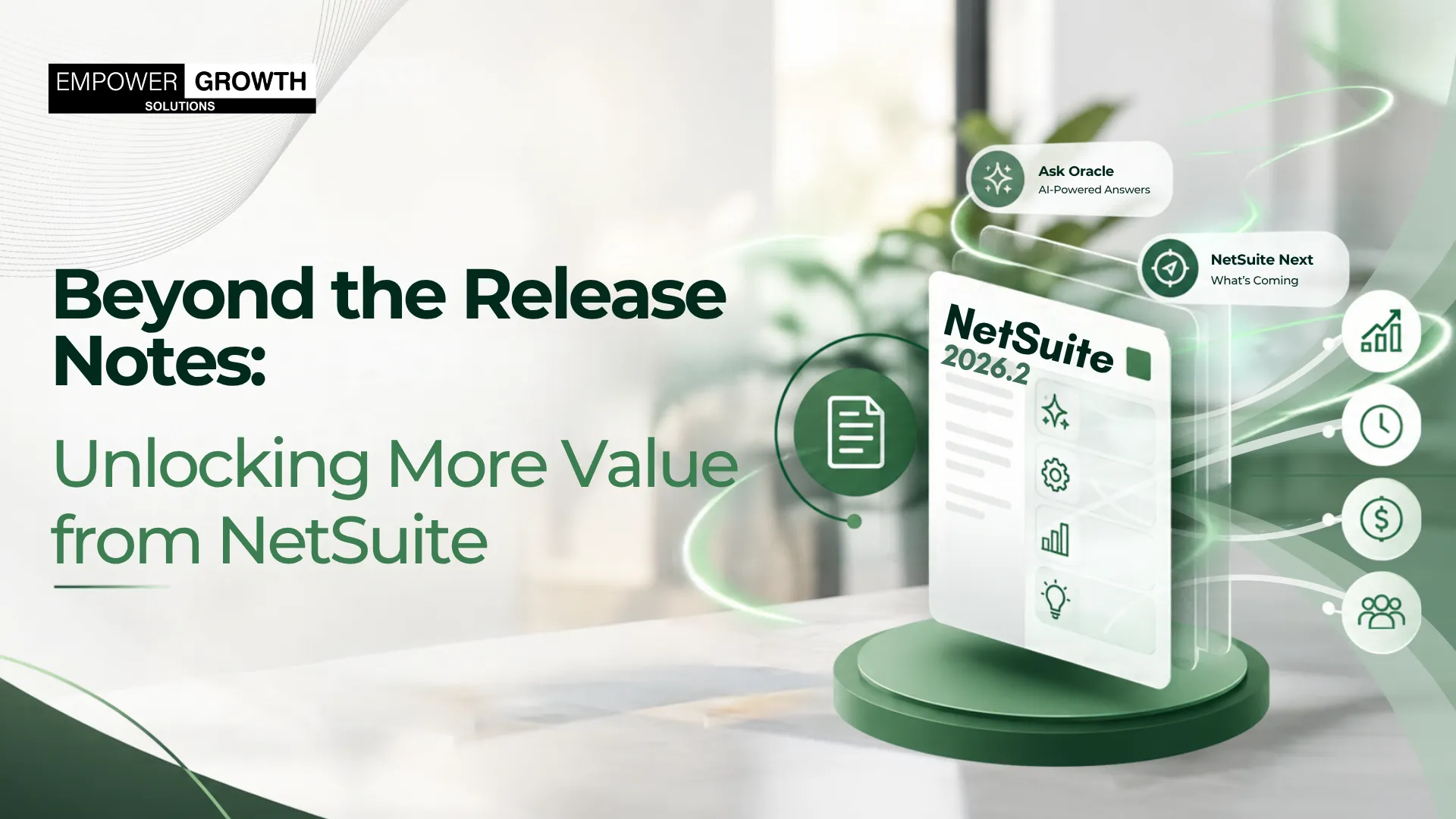
Every NetSuite release brings a fresh list of features. Most teams skim it, bookmark a few items "to look into later," and go back to the workarounds they've already built. That's not a knock on anyone - it's just what happens when release notes are treated as the finish line instead of the starting point.
They're not the roadmap. They're the trigger. What you actually prioritize should come from your business, not from Oracle's change log.
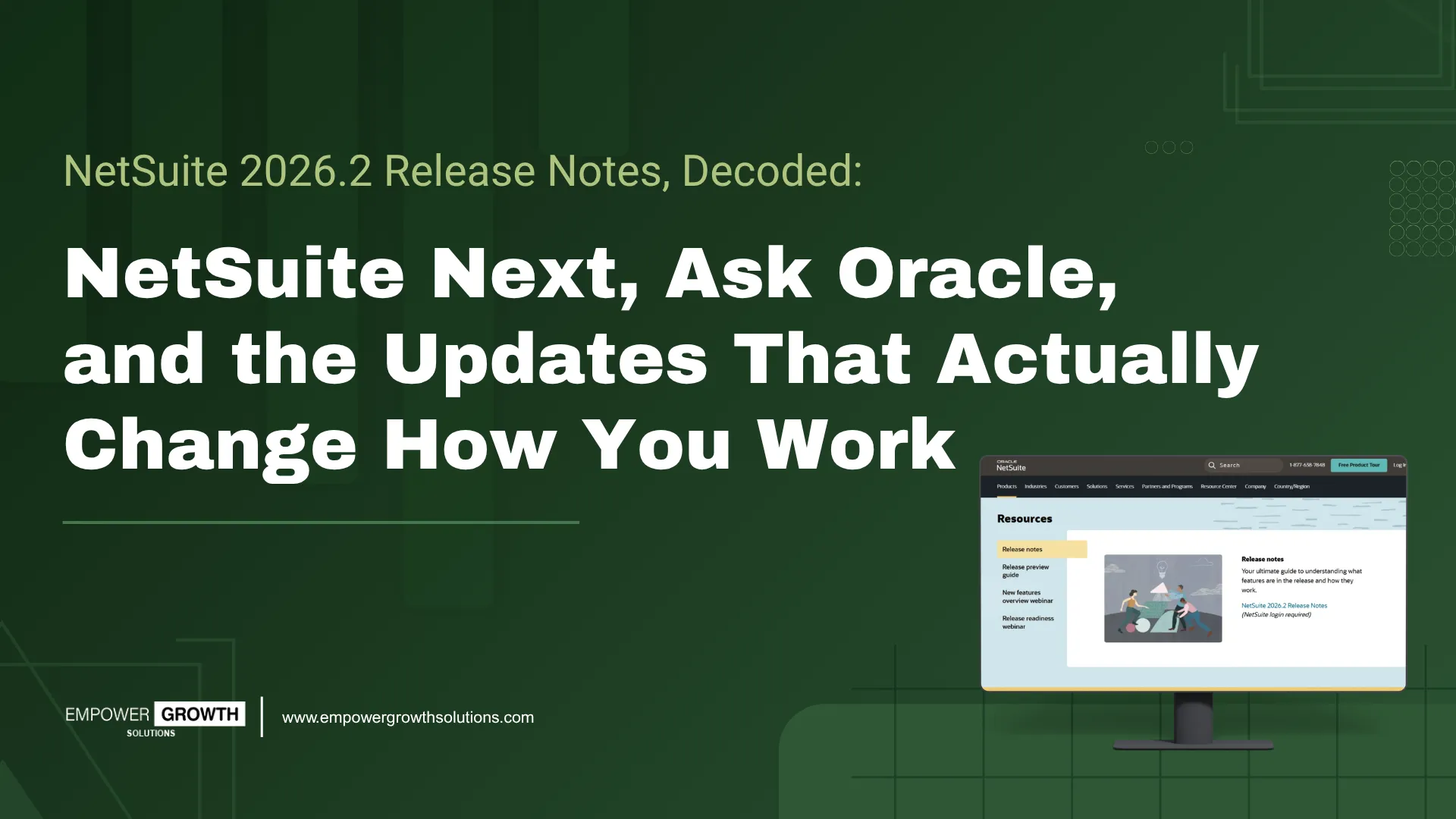
That distinction is the centre of our recent session, "Beyond the Release Notes: Unlocking More Value from NetSuite," where we walked through the NetSuite 2026.2 feature spotlight and a practical way to think about NetSuite optimization long after go-live. Watch the full recording below, then read on for the breakdown.
Does This Sound Familiar?
Before getting into what's new, it's worth running a quick gut check. If any of these describe your NetSuite environment today, you already have an optimization candidate sitting in front of you:
-
You still export NetSuite data to Excel to finish reporting.
-
Approvals or follow-ups happen over email or chat instead of in the system.
-
Month-end still depends on spreadsheets or manual checklists.
-
Your dashboards don't give leaders the answers they need.
-
You have scripts or workflows nobody wants to touch.
-
Your business has changed significantly since go-live, but your NetSuite setup hasn't.
If you checked even one box, this isn't about learning new NetSuite features for the sake of it. It's about closing gaps that are already costing you time.
NetSuite 2026.2: What Actually Deserves Attention
Not every line in a release notes document moves the needle for your business. Here's what stood out in 2026.2 for finance and operations teams - and why.
Ask Oracle: Practical AI Assistance in NetSuite
Ask Oracle lets users ask questions in natural language and find information inside NetSuite more intuitively, instead of hunting through menus and saved searches to get an answer.
Why it matters: Every minute a user spends navigating or searching for information is a minute not spent on the work that matters. Ask Oracle is a practical, low-lift example of AI assistance inside the platform - one that works alongside, not instead of, the broader NetSuite Next experience.
NetSuite Next: The Platform's Next-Generation Experience
Oracle is beginning the rollout of NetSuite Next, a refreshed interface with more AI-assisted ways of working built in. Availability and adoption options will vary by account, so this is one to watch rather than assume is live for everyone.
Why it matters: A more guided, intelligent experience can meaningfully reduce onboarding time and daily friction - but only for the roles and workflows where it's the right fit.
Smarter Financial Close and Transaction Matching
2026.2 pushes AI-powered financial management further with enhancements to Intelligent Close Manager and transaction matching. The goal is straightforward: reduce repetitive manual matching and let your team focus review time on actual exceptions instead of routine reconciliations.
Why it matters: faster, cleaner close cycles free up finance teams for higher-value analysis instead of chasing line items.
Automating Payment Adjustments
This release makes it possible to adjust payment differences - bank fees, convenience fees, minor underpayments - directly from the customer payment or deposit transaction, rather than through a separate manual adjusting entry.
Why it matters: less manual work, cleaner processing, and faster cash application. It's a small feature with an outsized effect on how often your AR team touches a transaction.
Everyday UX and Technical Readiness
Beyond the headline features, 2026.2 includes practical usability improvements that quietly remove small, recurring friction points and a reminder that integrations and customizations still need release testing before rollout. Neither is glamorous. Both matter.
Release Notes Are the Trigger - Not the Roadmap
Here's the mindset shift that separates teams who get real value from every release and teams who just accumulate unused features: a new capability in the release notes is a reason to evaluate not an instruction to adopt.
A simple filter helps:
-
New feature → Is there a real business use case for us?
-
Enhancement → Does it improve an existing process?
-
Behavior change → What needs regression testing before we roll it out?
-
Deprecation → What must be remediated, and by when?
From there, sort what's left into a straightforward action plan: quick win (adopt now), near-term (plan and configure), strategic (build the business case), or monitor (revisit later). Adoption should follow business value - not release cadence.
The Bigger Opportunity: What's Already in Your System
Here's the part most teams miss. The biggest wins aren't always in the newest release, they're sitting in capabilities you're already licensed for, or in process debt that's quietly built up since go-live.
Watch for the language your own team uses. These phrases are common signs of what we call optimization debt:
-
"We export this to Excel every month."
-
"Only one person knows how this works."
-
"We have a script for that - but nobody remembers why."
-
"The report is almost right, so we just fix it manually."
-
"We added this workaround right after go-live."
-
"Closing still takes too long."
These aren't just minor annoyances to live with. They're roadmap inputs. Go-live was never meant to be the finish line - as transaction volume grows, requirements change, and the platform itself evolves, your NetSuite instance needs to evolve with it. Left unaddressed, workarounds and manual processes tend to creep back in even after a clean implementation.
Two areas worth revisiting on almost every NetSuite instance:
-
AI used practically. Beyond any single new feature, AI capability inside NetSuite is most valuable when it removes friction from real work, analyzing patterns and anomalies faster, assisting with drafting and navigation, connecting governed AI access to your business data, and helping resolve exceptions and close issues. Permissions, data governance, and human review still matter here.
-
Analytics and operations together. Role-relevant dashboards saved searches that turn exception reporting into action, automated workflow approvals, and integrations that remove duplicate data entry, these compound over time in ways a single new feature rarely does.
Building a Living Optimization Roadmap
Once you've identified the opportunities - new release features and existing optimization debt alike - prioritize them with a simple value framework:
-
Business impact: How much value could this actually create?
-
Effort: How much time, cost, and complexity is involved?
-
Risk: What happens if we change this or if we do nothing?
-
Readiness: Do we have the data, process ownership, and change capacity to pull this off?
Then place each initiative on the roadmap: quick wins (high value, lower effort - adopt now), near-term (important and achievable), strategic (higher effort, transformational - build the business case), or monitor (not ready yet, or lower priority).
The point isn't to build a roadmap once and file it away. It's to prioritize, implement, measure, and revisit continuously, because your business will keep changing, and NetSuite should keep changing with it.
Three Things to Take Back to Your Team
-
Start with business pain - not feature Release notes are inputs. Your business outcomes should determine priorities.
-
Look at what you already have. Underused functionality and process debt can produce bigger wins than the newest feature.
-
Create a living roadmap. Prioritize, implement, measure, and revisit - on a continuous cycle, not a once-a-year project.
NetSuite should keep getting better as your business gets better. That takes more than knowing the feature list - it takes connecting NetSuite's capability to the way your business operates.
Ready to Find Your Quick Wins?
Optimization isn't a one-time project, it's a discipline. If you're not sure where your NetSuite instance is leaving value on the table, that's exactly the conversation to have.
Book a complimentary 30-minute NetSuite Optimization Discovery Session with our team, and we'll help you separate the quick wins from the strategic bets grounded in how your business actually runs, not just what's in the latest release notes.


0 Comments