
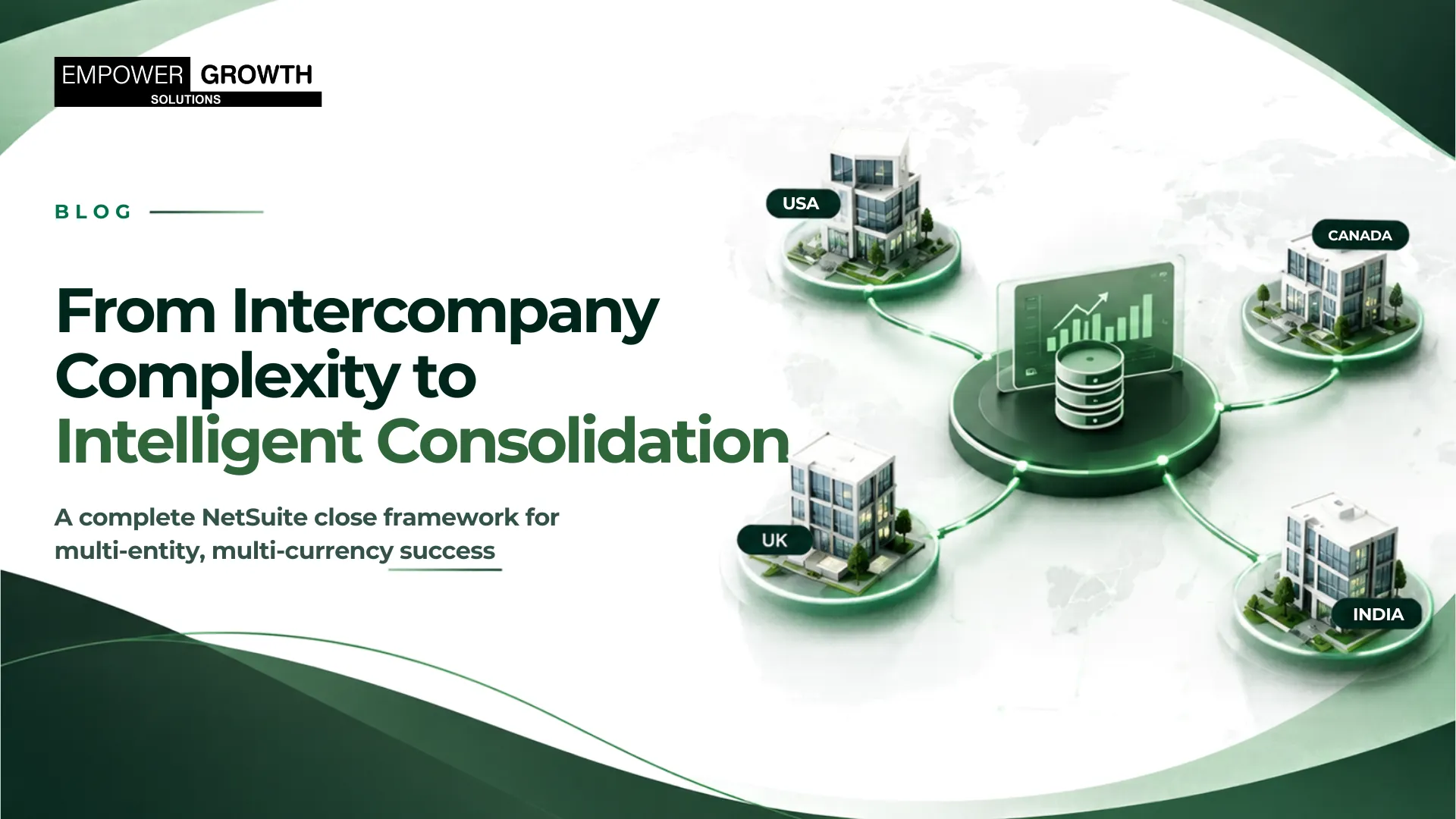
If you’ve ever managed a multi-entity financial close, you know the hardest part isn’t always the accounting.
Sometimes it’s an intercompany invoice that doesn’t match its counterpart. A subsidiary hasn’t completed its currency-related work. Or a transaction appears in an account nobody expected.
Each issue may seem manageable on its own. But when they start piling up, finance teams spend more time searching for answers than reviewing the numbers. And when the CFO asks, “Can we trust this result?”, the answer isn’t always as simple as it should be.
The real challenge isn’t just closing the books. It’s making sure the process is connected, controlled, and easy to explain.
That’s where NetSuite’s intercompany and financial close capabilities can help. By connecting transactions, close activities, exceptions, and reporting, finance teams can spend less time reconstructing what happened and more time understanding what the numbers mean.
When the Close Starts to Break Down
Picture a finance team preparing for month-end. The CFO is waiting for consolidated results, but the team is still working through questions.
An intercompany purchase order exists, but the related seller-side transaction isn’t easy to identify. A subsidiary hasn’t completed its foreign currency revaluation. A vendor’s information has changed and needs review. Somewhere else, a recurring invoice has been posted to an unexpected account.
None of these situations necessarily means something is wrong. But each creates another question someone needs to answer.
Soon, the team is checking records, comparing spreadsheets, searching emails, and contacting colleagues across subsidiaries. What should be a review of financial results becomes an exercise in reconstructing the evidence behind them.
And that’s often what makes the close difficult not the accounting itself, but the gaps between the activities.
Why Does the Close Stay Open?
A delayed close rarely comes down to one problem. More often, it reflects several smaller issues across subsidiaries, transactions, currencies, and close activities.
Different entities may follow different practices or timelines. Intercompany transactions add another layer because the buyer and seller may record the same economic event separately.
Then there are dependencies. Currency revaluation, consolidated exchange rates, and eliminations all have their place in the close sequence. When one activity isn’t complete, another may not be ready to move forward.
And finally, there’s the question of explanation. Producing a consolidated figure is one thing. Being able to explain why it changed and trace it back to the underlying transactions is another.
When evidence doesn’t travel with the transaction, every handoff creates more work.
Four Problems Finance Teams Recognize
Internal transactions don’t connect. An intercompany purchase order exists on one side and a sales order on the other. If the relationship isn’t clear, finance has to search for the corresponding records manually.
Reciprocal balances don’t match. Two subsidiaries may record the same internal activity, yet their receivables and payables don’t agree. The team must investigate the difference before consolidation.
One close activity depends on another. An elimination may be ready, but a required currency activity hasn’t been completed. The real problem is the dependency.
An unexpected transaction appears. A transaction may be completely legitimate, but finance still needs to understand why it appeared and whether action is required.
Different problems, same requirement: identify the issue, understand its context, and follow the evidence.
OneWorld Provides the Foundation
NetSuite OneWorld provides the foundation for managing subsidiaries, currencies, accounting books, intercompany transactions, consolidation, and reporting.
When configured correctly, finance teams can follow the financial story from the original transaction through to the consolidated result without rebuilding everything outside the ERP.
The legal structure defines subsidiaries, currencies, and accounting books. Intercompany processes manage relationships between internal buyers and sellers. Close activities bring together currency processes, eliminations, and period controls. Reporting and analytics help finance understand the final results.
A well-designed foundation makes it easier to reconcile activity, manage dependencies, and explain the numbers.
A Better Way to Think About the Close: Detect → Connect → Close → Explain
A practical way to approach intercompany consolidation is through four connected actions:
Detect → Connect → Close → Explain

1. Detect: Find Problems Earlier
The first question is simple: What requires attention?
NetSuite Exception Management can help identify unusual activity that may need review, such as unexpected transaction amounts, unusual account activity, vendor information changes, or recurring transactions that haven’t appeared as expected.
The goal isn’t to assume every unusual transaction is an error. It’s to bring potentially important activity to the team’s attention.
For example, a vendor change may be legitimate, but finance may want to confirm it before payment activity continues.
Exception Management does require preparation. Availability depends on account eligibility, configuration, historical transaction data, model readiness, and permissions. Customer-specific models also need suitable historical activity where applicable.
The objective is not to replace human judgment. It’s to help finance focus that judgment where it matters most.
2. Connect: Stop Chasing the Intercompany Trail
Once an issue is identified, the next question is: What is this transaction connected to?
NetSuite’s intercompany capabilities help finance establish and review relationships between buyer-side and seller-side activity.
Reconcile Reciprocal Balances
The Intercompany Reconciliation view helps users review the relationship between the two sides of an intercompany transaction and investigate differences using linked transaction information.
Eliminate Internal Activity
Once eligible intercompany activity has been reconciled, corresponding internal activity can be eliminated from consolidated results.
The distinction matters:
Reconciliation helps determine whether the two sides agree. Elimination removes eligible internal activity from consolidated reporting.
They are related, but they serve different purposes. Differences should be understood before elimination, so automation doesn’t hide unresolved issues.
3. Close: Know What’s Still Open
Every finance team has asked: “What are we still waiting on?”
When close activities are scattered across spreadsheets, checklists, and conversations, answering that question can take too long.
Intelligent Close Manager provides a central view of close activities, helping teams see what is completed, what remains open, and which activities depend on one another.
Depending on configuration, this can include system-generated tasks, user-created tasks, exceptions, close progress, period locks, and close summaries.
A useful close view should answer four questions:
What needs attention? Who owns it? What is holding things up? Where is the supporting evidence?
That’s the difference between knowing something is unfinished and understanding why.
4. Explain: Connect the Number to the Source
Producing a consolidated report is only part of the job.
Sooner or later, someone will ask: “Why did this number change?”
SuiteAnalytics can help finance move from consolidated results toward subsidiary, account, and transaction-level detail, depending on the reporting and drill-down configuration.
The actual numbers will vary by organization. What matters is having a clear path from the result back to the evidence.
A number becomes much more useful when the people reviewing it can understand where it came from.
Getting the Architecture Right
Automation cannot compensate for an incorrect underlying structure.
The subsidiary hierarchy should reflect the organization’s legal, tax, and consolidation requirements. The elimination entity should be positioned appropriately. Currency configuration should reflect the relationship between subsidiaries and their parent.
Shared classifications and intercompany accounts should also be used consistently.
For example, a Global Parent may report in USD, with US Operations using USD and Canada Operations using CAD, alongside an Elimination entity aligned with the parent structure.
This is only an illustration. The right setup depends on the organization’s legal structure, reporting requirements, and accounting processes.
Your NetSuite structure should reflect how your business actually operates.
Consolidated Rates and Multi-Book Controls
Multi-currency consolidation introduces another layer of detail.
Different account types may require different translation approaches. Current rates are commonly used for many assets and liabilities, average rates for income statement accounts, and historical rates for equity and selected long-lived assets where preserving the original basis is important.
|
Rate Type |
Common Use |
Close Consideration |
|
Current |
Most assets and liabilities |
Review the applicable period-end rate |
|
Average |
Income statement accounts |
Validate against relevant period activity |
|
Historical |
Equity and selected long-lived assets |
Preserve the appropriate historical basis |
Organizations using Multi-Book accounting also need to consider how close activities behave across different accounting books. The outcome can depend on enabled features, implementation choices, roles, and scripts, so the configuration should be reviewed against actual accounting requirements.
The Close Dependency Chain
Once the foundation is sound, the close can follow a logical sequence:
1. Lock Modules — Establish the appropriate posting cutoff.
2. Revalue Foreign Currency — Update open foreign-currency balances as required.
3. Calculate Consolidated Rates — Translate subsidiary activity using appropriate rates.
4. Eliminate — Generate required elimination activity for eligible intercompany transactions.
5. Review — Inspect reports, exceptions, and supporting evidence.
6. Close — Prevent further posting when the period is ready.
These activities are connected. Intelligent Close Manager can help make those dependencies more visible so teams can address prerequisites before they become close-day problems.
From Setup to Ongoing Exception Review
Getting Exception Management ready for production requires more than switching it on.
A practical approach is:
Enable the relevant periods, models, and interface components.
Train customer-specific models using consistent historical activity where applicable.
Tune thresholds and exclusions to reflect the organization’s risk profile.
Review flagged transactions and determine whether action is required.
Before relying on the capability in production, confirm account eligibility, historical data, model readiness, and user permissions.
Turning the Framework Into a Practical Project
Organizations don’t have to redesign the entire close at once.
Phase 1: Diagnose
Review the subsidiary structure, intercompany flows, currency processes, account configuration, close dependencies, ownership, and supporting evidence. Identify where the process breaks down.
Phase 2: Stabilize
Resolve intercompany pairing issues, test elimination activities, configure close tasks, document dependencies, and establish ownership.
Phase 3: Scale
Once the foundation is stable, expand analytics, exception monitoring, and AI-assisted review where appropriate. Role-based reporting can help teams focus on information relevant to their responsibilities.
Throughout the project, ownership matters. Who owns the initiative? Who controls the process? Which problem should be addressed first? How will improvement be measured?
Technology is only part of the solution. The process around it matters just as much.
Measure Control, Not Just Speed
A faster close isn’t necessarily a better close.
If finance still struggles to trace transactions, investigate differences, or retain supporting evidence, the underlying problem remains.
A stronger approach also looks at whether intercompany transactions are easier to reconcile, variances are easier to investigate, manual elimination work is reduced, evidence is retained, and dependencies are visible before they cause delays.
The real improvement is being able to close with greater confidence in both the numbers and the evidence behind them.
Three Capabilities. One Connected Answer
The framework comes down to three practical ideas.
Connect the Pair. Link buyer-side and seller-side transactions so finance doesn’t have to reconstruct the relationship later.
Automate the Close. Use close management, dependencies, and elimination capabilities to create a more structured process.
Explain the Result. Create a clear path from the consolidated number to the subsidiary, account, and underlying transaction.
When these capabilities work together, the close becomes more than a collection of accounting tasks. It becomes a connected process finance teams can monitor, investigate, and explain.
From Close Surprise to Executive Answer
Imagine finance identifies an unusual transaction during the close. The team reviews the source record through Exception Management and determines what happened.
Next, they investigate the intercompany relationship and review the linked buyer-side and seller-side transactions.
Once the issue is addressed, Intelligent Close Manager helps the team review outstanding prerequisites and complete the required close activities, including elimination.
Finally, SuiteAnalytics helps finance review the consolidated result and trace it back to subsidiary and transaction-level detail.
The process moves from identifying the issue → understanding the relationship → completing the close → explaining the result.
That’s the difference between simply producing a number and being able to stand behind it.
What Should Your Close Stop Making You Chase?
Every multi-entity organization has its own version of the same challenge.
Maybe it’s an intercompany transaction without a complete record chain. Maybe it’s an unusual posting discovered too late. Perhaps a currency task is holding up the next stage. Or maybe the biggest frustration is explaining a consolidated number that should be easier to understand.
These problems may look different, but they point to the same question:
Can your team see what is happening, understand what is connected, and trace the final result back to the source?
That’s worth examining before the next close begins not when the pressure is already building.
Ready to Find Where Your Close Breaks Down?
Every multi-entity close has pressure points.
A transaction without a complete chain. A subsidiary waiting on another process. A currency task holding up the next step. An unexpected posting that needs investigation. A consolidated figure that takes too much effort to explain.
The question isn’t whether your close has dependencies. It does.
The more important question is whether your team can see those dependencies clearly, resolve issues efficiently, and maintain a reliable trail of evidence throughout the process.
We’ll help you map your current consolidation process against this framework, identify where your existing processes are working well, and uncover where information or evidence may be getting lost along the way.


0 Comments